
The rich tapestry of what is AI
Table of Contents
Introduction
There is a lot of talk in the media these days about Artificial Intelligence (AI) along many differing opinions … can all these opinions be correct ? Is everyone talking about the same AI ? After all, the term was coined back in 1955 by John McCarthy … is this the same AI we talk about today ? Even the Bletchley Declaration fails to define AI.
Here we attempt to tease apart the different possible meanings of AI, so we can be a little more concise when we discuss AI.
Artificial intelligence
Wikipedia gives us the following definition, Artificial intelligence (AI) is the intelligence of machines or software, as opposed to the intelligence of humans or animals., which is fine as far as it goes … yet it doesn’t really help us that much. We need to dig further.
Machine learning
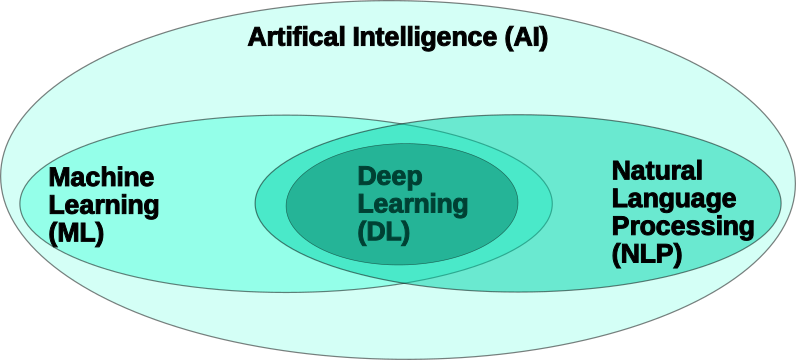
A common element of AI is Machine Learning (ML). Again, Wikipedia helps us out here with the following definition, Machine learning (ML) is a field of study in artificial intelligence concerned with the development and study of statistical algorithms that can effectively generalize and thus perform tasks without explicit instructions.
This is more helpful – traditional programming methods, such as imperative and declarative, require a human to write some code. ML is different … such systems can be trained from a set of data (usually very large) and then, when fed with new data, produce new results.
Pattern recognition
Many ML implementations can be categorised as pattern recognition systems. During training, the system learns to recognise patterns, then applies the pattern recognition to new data. There is no “understanding” of the data as such.
Examples of pattern recognition include :
- Arthur Samuels checker game (1959)
- Email spam filtering – filter out unwanted emails
- Image recognition – is there a bird or a fox in the picture
- Healthcare – analysing X-rays for tumours
Whilst these examples are certainly useful AI applications, they can’t really be considered to be intelligent – you wouldn’t expect your spam filter to start creating art.
Training
ML implementations need to be trained, this is usually achieved by injecting test data, comparing the output with the desired output and updating the implementation to do better. Such training requires large amounts of accurate test data as well as large compute resources to complete.
However, if your test data is inaccurate or incomplete, you will get inaccurate results. Imagine training a bird recognition system with a set of bird pictures that only included male blackbirds ? Such a system wouldn’t be able to correctly identify female blackbirds. This topic is explored in depth in the documentary coded bias.
There are other complexities as well with training – for example, what happens if the training takes too long or never converges on a solution ?
Implementations
There are several ways to implement ML such as Random Forests or k-nearest neighbors, however artificial neural networks (ANN) has become the most common method.
ANN is inspired by biological neurons in the brain and consists of layers of neurons connected together into a network or model. These models can be run on traditional computers or with specialist hardware.
Other potential challenges
Since ML implementations differ to traditional programming methods, aside from training challenges, they can be subject to additional issues such as :
- Unexpected or incorrect outputs
- Difficult to diagnose failures
- Deployed in hidden or unexpected places
The last point is discussed in the documentary the social dilemma, which discusses how social networks use AI to get you to stay online and so view more advertisements. It also has the effect of amplifying conspiracy theories such as pizzagate.
However, with proper design, training and above all testing, ML implementations can be a great alternative to traditional solutions.
Deep learning
Around the 1990s, research into artificial neural networks started to produce breakthroughs. Training was better understood and optimised for both speed and accuracy. Also, larger multi layered models were developed that were capable of more complex tasks. Of course, higher computer power was more readily available.
Deep learning is a term applied to these more complex artificial neural networks.
Examples of deep learning AI include :
- Deep blue chess
- Voice to text – Alexa, what time is it ?
- Drug discovery
- Fraud detection
Deep learning applications can be applied to more complex applications than the earlier, simpler, ML models, but have similar potential drawbacks. Deep learning applications remain single use – i.e. a chess model can’t discover new drugs.
Generative AI
In the early 2020s, research into generative models produced a new type of artificial neural network called Generative artificial intelligence. Unlike what came before, these models generate large responses from little input. They consist of large and complex models and are trained with huge amounts of data (only large data centres can be used for training!).
Large language model
One type of generative AI is large language models (LLM). Once trained, these accept natural language and produce a very natural response.
At a simplistic level, LLM works similarly to text prediction on your mobile phone – based on its learning, it predicts what text comes next.
LLM produces remarkable results.
Examples of LLM include :
Aside from chat systems, LLMs are used in applications such as summarising searches, code generation and correction, text summary and text translation.
Like all the AI types discussed above, LLM remains dependent on quality test data – train it with right-wing views and the LLM also becomes right wing. Hence, public implementations have to be guarded to avoid giving inappropriate responses. LLMs are subject to hallucinations where a response is false but presented as fact.
Text to image
Another type of generative AI is text-to-image. Like LLM, these accept natural language but instead generate an image.
Examples of text-to-image include :
- Stable Diffusion Online
- Muse AI’s Midjourney
- Open AI’s Dall-E
- Microsoft’s bing image creator
Summary
So the term AI can mean anything from a simple checkers game from 1959 to today’s ChatGPT … different types of AI have different uses, characteristics and therefore different risks and benefits.
If you see the term AI, the chances are it’s a reference to the most recent Generative AI … but it would sure be helpful if we were more concise !